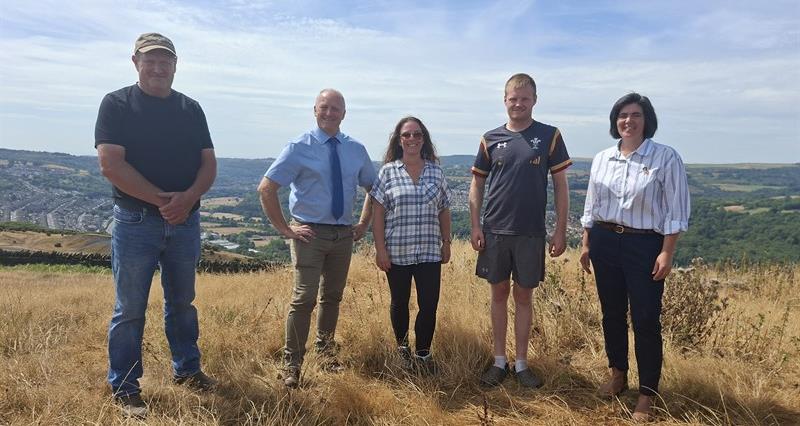
Joining the visit of Welsh Labour MS, Vikki Howells to the farm near Cilfynydd were NFU Cymru President Abi Reader and Deputy President Paul Williams.
Mitigating and managing fire risk
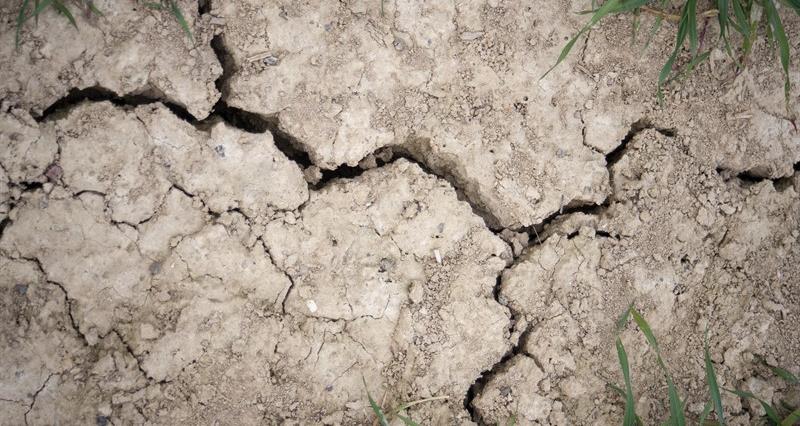
With the current drought conditions having led to wildfires across Wales, including in the south Wales areas, those present were keen to discuss the fire risk and how it might be mitigated and managed in future, as prolonged dry and warm periods appear to be coming more common occurrences.
Jonathan Huntely said ‘Wildfires, like any type of fire need fuel to sustain them. With the loss of sheep and cattle from the hills we are seeing the year-on-year build-up of the very material which will allow wildfires to burn when the weather conditions have made everything tinder dry.”
Declining livestock numbers
Picking up on the theme of declining livestock numbers NFU Cymru President Abi Reader said:
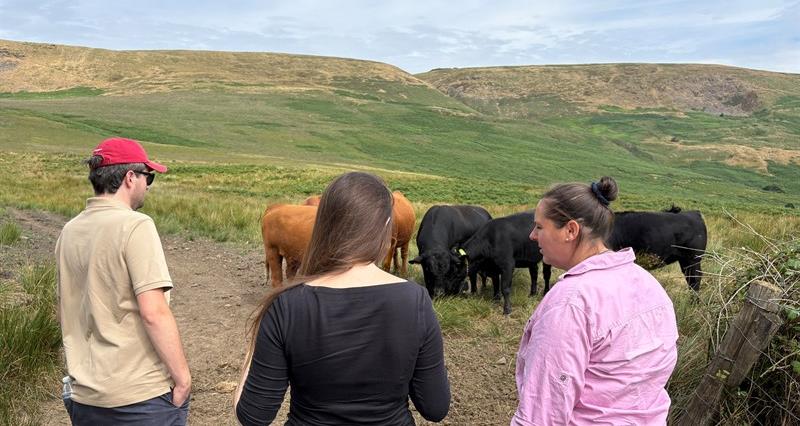
“The significant declines we have seen in livestock numbers over recent years, particularly amongst our beef suckler herd, means that fewer animals now graze our upland areas, Not only does this lead to fire-risk in our hills and higher ground, but it also risks the loss of critical mass in our food supply chains.
Arrest and reverse
Working with the Senedd and Welsh Government, we need to arrest and reverse this decline in numbers to ensure that we address the fire risk caused by under grazing whilst at the same time safeguarding the viability of the Welsh food processing sector."
Some issues related to the Sustainable Farming Scheme were also discussed, with NFU Cymru Deputy President Paul Williams saying:
“Some 50% of farmers went into the SFS scheme this year. There is therefore scope to increase scheme participation and we welcome last month’s announcement by Welsh Government to align the Animal Health Improvement Cycle with Farm Assurance requirements, a move which strips out some of the duplication from the scheme.
However, to broaden the appeal of the scheme further and secure wider uptake we continue to urge the Welsh Government to look again at hedge management requirements, how the scheme can be made more attractive to tenant farmers as well as looking at the introduction of more temporary habitat options.”
Secure food production
This year’s drought conditions as well as global events have served as a timely reminder of the importance of farm support and of having a secure domestic food production, with Mr Huntley commenting:
“The stability which was provided by the BPS and in future through the Universal layer of the SFS, particularly the social value payment in the SFS, contributes significantly to farm business viability. This has really shown its worth in these testing times of global instability and challenging weather conditions that we are seeing.”
Bovine TB
Bovine TB was also a discussion matter, Abi Reader said:
“The debate on TB which took place at the Senedd just before summer recess showed that all parties understood the emotional and financial strain a TB breakdown places on a farming family, and I thank Vikki Howells for raising these important points during her contribution.
“TB is a complicated disease and if we are to ever have any hope of eradicating it then we cannot shy away from a strategy which deploys the right intervention in the right place at the right time, guided by the local disease picture. The must be room in such a strategy for interventions which include measures targeting diseased wildlife.”
Concluding Abi Reader said:
“With Vikki now Labour spokesperson on Environment, Rural Affairs, Energy and Transport at the Senedd and also sitting on the Senedd’s Climate Change, Environment, Sustainability and Rural Affairs Committee it was very timely to be able to welcome her out to farm for a discussion on these issues and more, issues that the Senedd CCESRA Committee is almost certain to be looking at over the course of the next few years.”