Senedd election changes - what you need to know

18 Chwefror 2026

Joe Rees Jones

With less than 100 days until the polls open on May 7 to elect the seventh Senedd Cymru, this is the first of three updates giving members an overview of the upcoming election.

This article summarises the much talked about changes to the next Senedd itself as well as the election process before it. While we outline a summary of the changes below, a question often asked is where did these changes come from?

In short, the idea of a full Welsh parliament of up to 100 elected members goes back as far as the Wilson governments in the 1970s. Since the then-Welsh Assembly’s inception in 1999 there has been an ongoing shift towards this original inception with numerous committees and commitments made across the political spectrum. From the 2011 referendum to four national consultations in just the last five years, the idea of needing to reform the Senedd and wider political system reached its climax when in May 2024 MSs voted 43-16 in favour of the Senedd Cymru (Members and Elections) Bill, making the changes we now see into law.

All change on polling day

Despite this long history to get here, voters in Wales will now begin see this change all come to fruition on one single polling day. Even from a short summary, it’s clear this election may be unlike any other in the last quarter century of devolution, one that perhaps may not be fully understood until May 7.
Overview

  • Increase from 60 to 96 Members of the Senedd (MS)
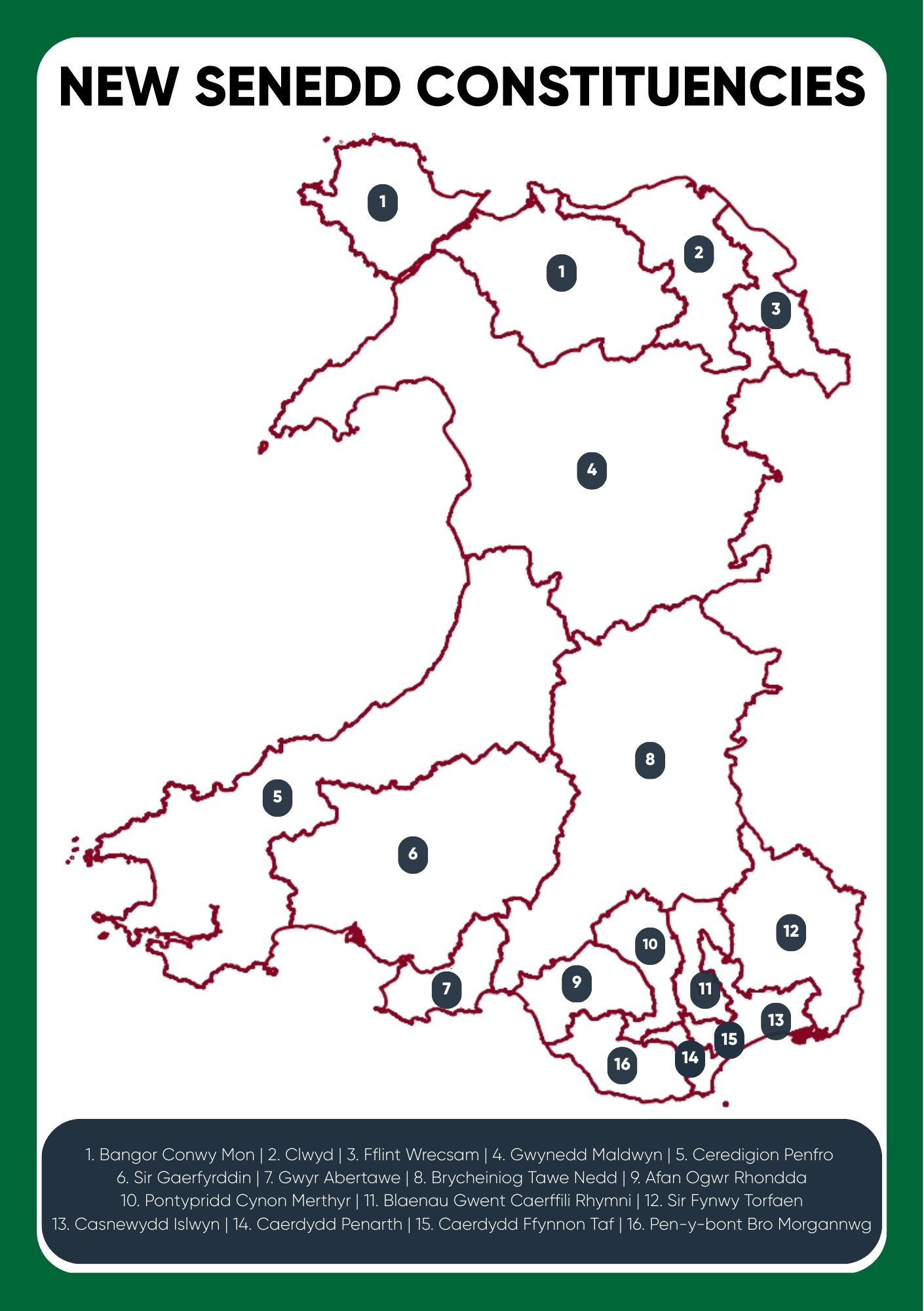
  • 16 new constituencies with 6 MSs per ‘Super’ Constituency
  • New electoral system of ‘Closed List Proportional Representation’.

New constituencies

  • Previous 40/20 split of constituency and regional seats replaced by 16 'Super Constituencies'
  • Each new constituency has been formed by combining two adjacent Westminster constituencies
  • The constituencies are designed to have on average 150,000 registered voters
  • The combination of large constituencies and the new electoral system means there are no 'safe seats' nor any constituency entirely urban or rural
  • All 16 can be reviewed again before 2030.

New electoral system

  • The new system is called Closed List Proportional Representation and was used previously for regional candidates
  • Voters now vote for a political party rather than an individual candidate (unless independent)
  • For each constituency, political parties will create a ranked list of up to 8 candidates
  • Once polls close and counting is complete, a mathematical formula called the D’Hondt Method is used to allocate seats to parties according to the number of votes cast for each party
  • Although not perfectly proportional, this system produces results which should align vote-share fairly closely to overall seat-share

Increase in members

  • The previous system of 40 Constituency Members and 20 Regional Members has been replaced by an increase to 96 members all elected from constituencies
  • The maximum number of MSs who can serve as Ministers in the Welsh Government will increase to seventeen.

Other changes

  • Term lengths are returning to 4 years instead of 5 
  • Candidates must reside in Wales
  • Town and Community Councillors cannot be Senedd Members at the same time
  • Re-call mechanism proposed (and currently being legislated for in the Senedd)

Key dates

Senedd dissolved: 8 April

Election Day: 7 May

Deadline for new First Minister: 3 June


Gofynnwch gwestiwn i ni am y dudalen hon

Unwaith y byddwch wedi cyflwyno’ch ymholiad bydd NFU Cymru yn cysylltu â chi ac, os yw’n briodol, bydd eich cwestiwn yn cael ei drosglwyddo i un o’n timau polisi.

You have 0 characters remaining.

By completing the form with your details on this page, you are agreeing to have this information sent to the NFU for the purposes of contacting you regarding your enquiry. Please take time to read the NFU’s Privacy Notice if you require further information.