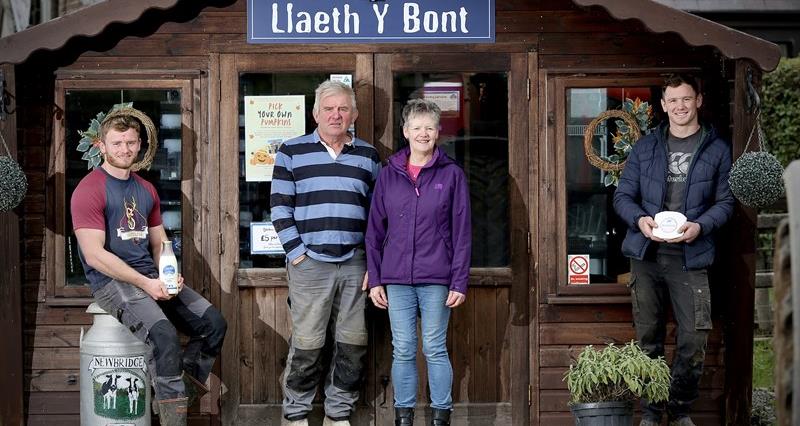
An ambitious and enterprising approach to direct sales has brought a Mid Wales dairy farm closer to its customer base.
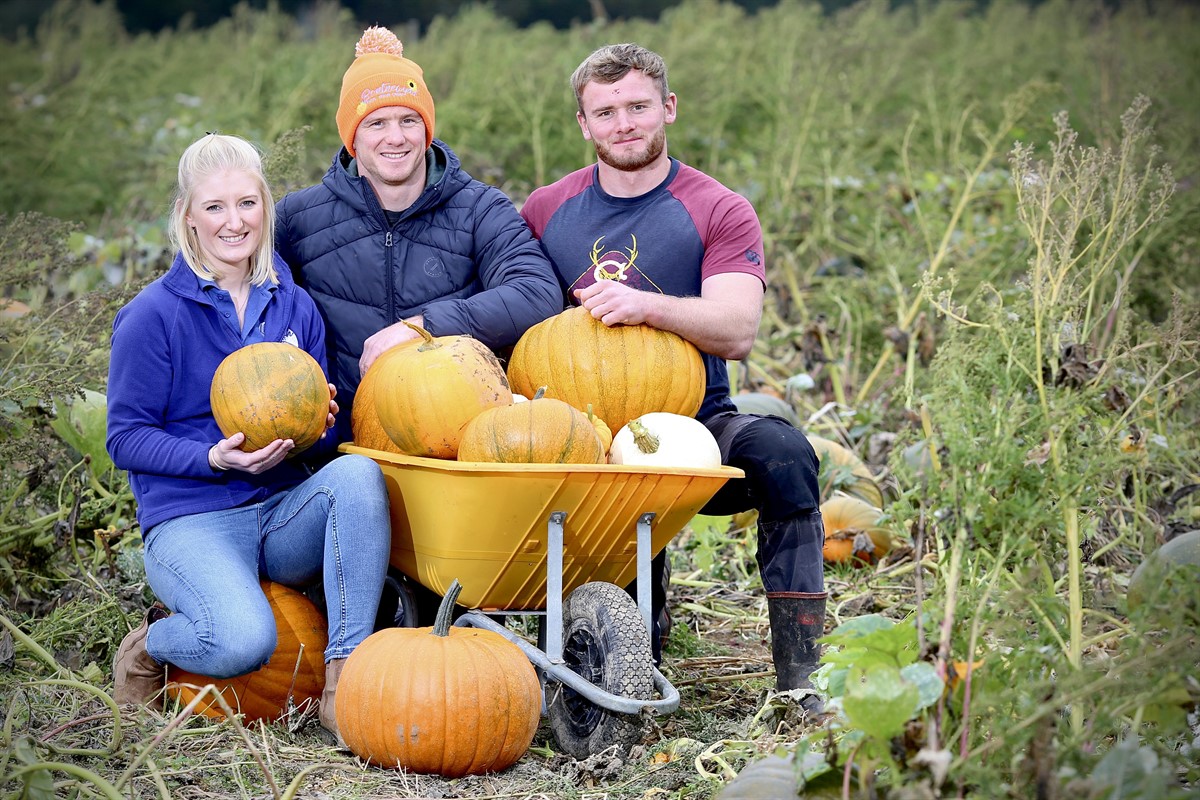
A fortnight before Halloween, for example, Newbridge Farm, Meifod, does a roaring trade selling pumpkins grown on a half acre of land for hordes of pick-your-own customers.
Many of those customers also take the opportunity to stock up on milk, fresh Llaeth y Bont milk from the farm’s vending machine, produced that day by its 220-cow dairy herd.
Expansion
That herd has doubled in size since John and Eirian Williams’ two sons joined the business, and there are plans to increase numbers further and to add more alternative income streams.
The Williamses had to take a fresh look at the business when Llewelyn and Ieuan came home to farm to generate the income needed to support everyone.

The dairy enterprise is, and was, the principal earner but it needed to grow beyond a 100-cow herd.
To facilitate that expansion, the Williamses sold their flock of sheep and scaled back the beef enterprise.
"The dairy herd was making most of the money and the beef and sheep weren’t, they were just ticking over, so reviewing the business allowed us to push cow numbers up to 220," says Ieuan.
Work experience
Now 31, and a member of the NFU Cymru Next Generation Board, Ieuan came home to farm in 2017 after studying agriculture at Aberystwyth, which included a placement in New Zealand.
It was there, on a large-scale dairy farm in Southland, that he gained a wealth of knowledge on calf rearing, which to this day is the job he finds the most enjoyable and satisfying of all.
"I like seeing happy and healthy calves that are thriving, it’s a proud moment when they enter the milking herd," he says.
The herd is transitioning from all-year-round calving to a split block pattern, principally an autumn block to meet milk demand at that time of the year and encouraged by the farm’s milk buyer, Arla.
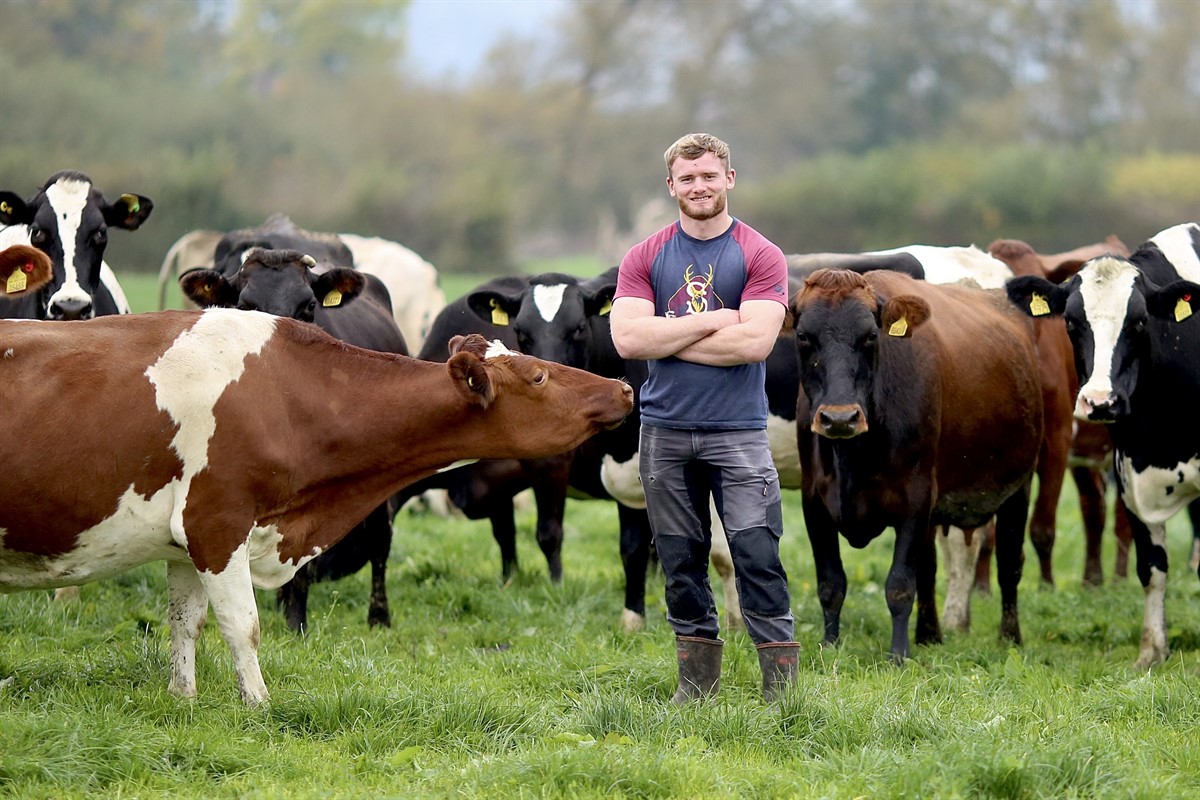
There are Holsteins, Friesians, Norwegian Reds and Jersey crosses but the breeding programme is now focussed on producing a small stature Holstein, what Ieuan describes as an 'in-between cow'.
"We want a cow that is going to give a lot of milk but one that is smaller than the traditional Holstein, she needs to be healthy and hardy," Ieuan explains.
The herd currently produces an annual milk yield average per cow of 8,000 litres at 4.5% butterfat and 3.5% protein, with cows milked in a herringbone parlour.
To facilitate expansion, groups of cows have been sourced direct from farms or at marts but next year there should be sufficient heifers coming through for all replacements to be bred in-house.
Grazed grass is an important component in the herd diet with a paddock system in place on the grazing platform.
Ieuan is a member of a Farming Connect grassland dairy discussion group which has helped increase his knowledge of grazing.
Knowledge transfer
Podcasts and YouTube videos are also good sources of information, he says. "I listen to a lot of podcasts, from New Zealand, America, Ireland and the UK.
"There is a lot of research out there which can get a bit confusing and the people on these podcasts simplify it, all I need to do is to press play and I can listen to it on the job.
"It’s the same with YouTube, there are farmers on those videos describing their week and I might pick up on one really good idea from that."
Ieuan’s ambition was always to farm, he never contemplated anything else, and that was true of many of his schoolfriends.
In his GCSE agriculture class at Ysgol Bro Caereinion he had 29 classmates. "I was very lucky that there were so many of us who all shared the same interest," he reflects.
He had many mentors and role models during his university years and his role on the NFU Cymru Next Generation Board also brings him into contact with people who inspire him.
Inspiration
Ieuan’s placement year in New Zealand was inspirational too – he reckons it is important for farmer’s sons and daughters to spend time working on other farms before they return to the family business. "Getting off farm and seeing how other farms operate, hearing their ideas, is vital."
Expansion was in part made possible when Ieuan’s great-uncle, Meurig, a bachelor, made the family the beneficiary of his farm when he died two years ago.
That farm is a couple of miles away from Newbridge Farm and is where the youngstock are reared. That land is being drained and reseeded and grazing infrastructure put in place for the calves.
Meurig’s bequest increased the land base to 400 acres. Had the inheritance tax reforms been in place when he died, the opportunity to grow the business might not have been possible, Ieuan points out.
Further diversification
Ieuan and his wife, Catrin, a talented artist, have built a house on that farm and are in the process of cultivating a large garden, planting vegetables and fruit trees to feed themselves and to sell produce going forward – they have already created an Instagram page, cartref_williams.
They make their own butter, yoghurt, pasta and sourdough bread, to eat more food as ‘nature intended’ as a kickback against ultra processed foods which now account for so much of the nation’s diet.
“Diet plays such a big role in mental and physical health," Ieuan rightly points out. “I do a lot of work in the gym and play rugby and am aware that my recovery after a game takes much longer if I haven’t been eating properly."
Ieuan and Catrin plan to sell some of those foods to others too, adding another income stream.
In the autumn, it is the pumpkins that keep the family busy, with half an acre making an eye-catching and popular autumn tapestry woven from the multiple sizes, shapes and colours. It is their second diversification following the milk vending machine which was installed during the pandemic.
Pumpkins
That machine drew a lot of customers so it concentrated the family’s minds on other diversifications. "Once we took that dive we thought we would have a go at pumpkins, when you jump into one thing you want to see what else you can do," says Ieuan.
The exceptionally dry conditions which characterised 2025 made it a challenging year for growing pumpkins – there were times when weeds threatened to smother the crop.
“We weren’t sure how many pumpkins would survive but when we cut the weeds back there were plenty, the weeds did create a lot of work though," Ieuan admits.
Which varieties to grow and how to run a PYO business were informed by visits to other growers. "We grew a lot of varieties initially but came to understand which ones were the most popular," says Ieuan.
With the pumpkin season comes a peak in sales of milk too – an average of 30 litres of milk a day is sold throughout the year from the vending machine but that increases in October.
Although Newbridge Farm isn’t in a region with a big population, there are no other vending machines for some distance and it has a loyal customer base.
Ieuan believes there are multiple reasons why people now prefer to buy milk direct. “It tastes better for one thing and people do care about carbon footprint.
“Our customers like to come to the farm too. We have donkeys and pigs in a nearby paddock so people are not just popping out to get milk they like to look around."
Holiday cottages
So too do the guests staying at the farm’s two holiday cottages. "They love to watch the cows being milked from our viewing balcony," he adds.
Milk from the Newbridge herd not only supplies the vending machine but is used to produce cheese. Llewelyn, who is engaged to Beth, is the cheesemaker, producing a soft cheese under the brand name, Bleddyn, and recently adding a Caerphilly.
For Beth, it is flowers that are her passion, growing these on the farm and selling them through her business, Banwy Blooms, from bouquets to arrangements for weddings, including the flowers at Ieuan and Catrin’s service and reception.
The Williamses are an industrious family. “Anything farmers can do to bring in a bit of extra cash or increase the value of their existing products helps, it goes a long way to supporting their core businesses," says Ieuan.
This will become ever more important with the ending of the Basic Payment Scheme and the transition to Wales’ Sustainable Farming Scheme, he adds.
He is far from convinced about some aspects of the scheme though and is troubled by analysis which shows big reductions in livestock numbers, jobs and farm income.
"Some of the changes the Welsh Government has made have improved the scheme but they need to consider further changes or the impact on the rural economy is going to be huge."
It is likely that the Williamses will join the scheme as their farm can meet the habitat requirements and they have a good amount of tree cover but Ieuan says stipulations within the SFS just won’t work for everyone.
“It doesn’t make sense to take large bits of highly productive land out of production just to tick a box on habitat at a time when food security has never been so important."