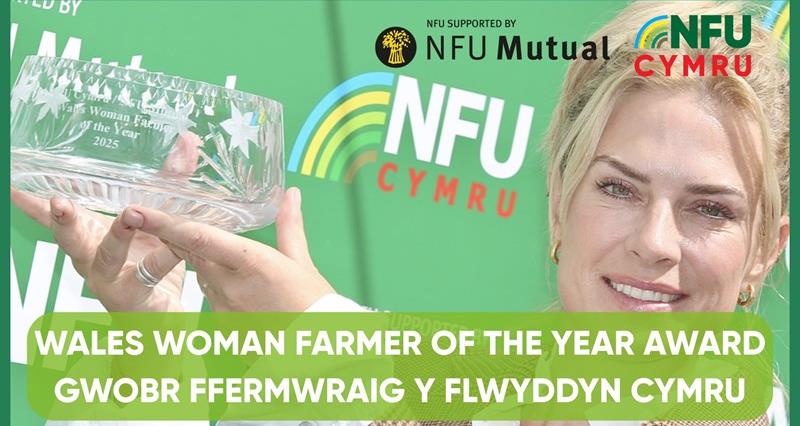
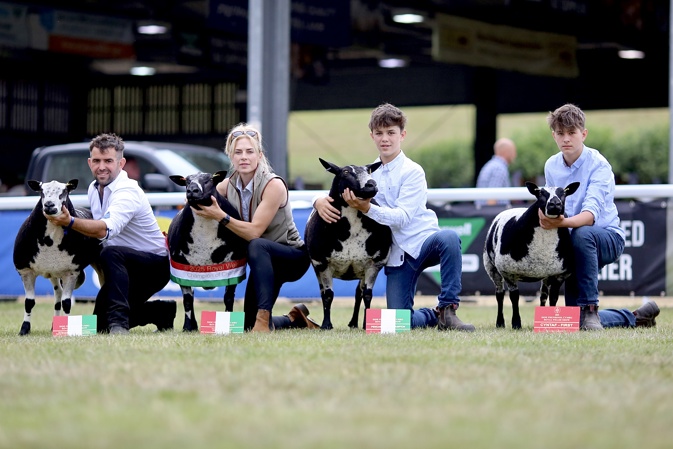
She has had success in the showring, with her shearling ram Cnewch HD II Est Beau scooping the Champion of Champions in the Royal Welsh Show Interbreed Championship, while Robbie herself was crowned NFU Cymru/NFU Mutual Wales Woman Farmer of the Year. Farming Wales writer Debbie James met with Robbie to learn about her farming heritage, a passion for the Dutch Spotted breed and sharing the everyday realities of farming on social media.
History and heritage
There are few people who have farming so deeply ingrained in their DNA as livestock farmer Robbie Alman-Wilson. Her ancestors first worked the land in the 1700s, possibly even earlier, a heritage firmly rooted in Radnorshire where every generation has since farmed and where she is maintaining that unbroken family link to agriculture, at Cnwch in Llanbister.
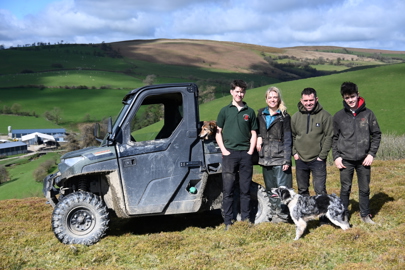
Here she farms with her husband, Dale, himself a fifth generation farmer, and his parents, Roy and Mair.
As a woman in agriculture, she is in the minority but even as a young girl, growing up on her own family’s farm at Gladestry, she had an innate love of farming and the countryside.
Initially she combined farming with equine pursuits - schooling horses - but as her commitments at Cnwch grew she scaled that down and eventually gave it up to concentrate on the sheep, beef and poultry enterprises. Robbie initially worked in the poultry side of the business, a free-range layer system established as a 12,000-hen flock in 2009.
Bird numbers were increased to 16,000, then doubled to 34,000 when a second shed was erected. Robbie later swapped roles with Roy - he is now responsible for the flock’s day to day management and her focus is on the sheep and cattle.
The family farms 600 acres of owned and rented land and also has grazing rights to 5,000 acres of common land on the Beacon Hill, where the hefted flock of Welsh ewes graze.
Why go Dutch?
There are multiple strands to the sheep business, the most recent developed six years ago with the purchase of two high value pedigree Dutch Spotted ewes from breeders in Scotland and England. That £4,600 investment was a significant one, says Robbie.
“Paying £3,000 and £1,600 for ewes seemed off the scale expensive for a hill farm like ours, it was a big thing for us to go into pedigree.” An embryo transfer programme followed and the initial outlay in those two animals has paid dividends.
Robbie’s expert eye for picking out a good sheep is evident. “When I saw the £3,000 ewe in the breeder’s video she was the one I had to have, but I could never have known that she would breed quite as well as she has.”
The breeding programme has augmented ewe numbers to around 60 and with that fl ock now established there will be revenue opportunities through sales of breeding stock at future pedigree sales.
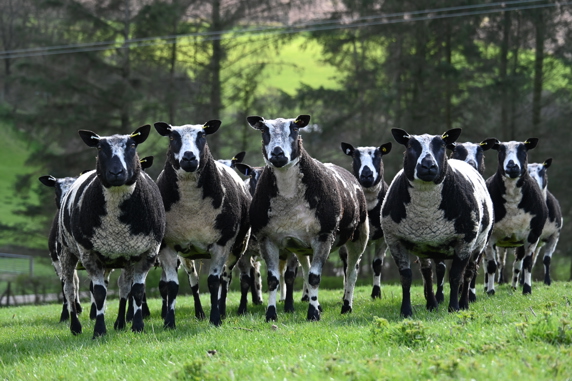
Why the Dutch Spotted? “I wanted a breed that was a bit different and the Dutch Spotted were making good money,” says Robbie.
“It can be hard to break into these markets but liking what you see helps, I liked the idea that if we wanted to use the Dutch Spotted on our crossbred ewes that we could.
“They can be lovely looking sheep, very sharp and elegant.” The pedigree flock lambs indoors in January followed by the Welsh ewes, which are sired to a Blue Faced Leicester tup.
Anything that isn’t in lamb to a Blue Faced Leicester is sired to a Welsh tup for breeding replacements, lambing in April along with crossbred ewes sired to a Texel or a Dutch Spotted, and the hill ewes.
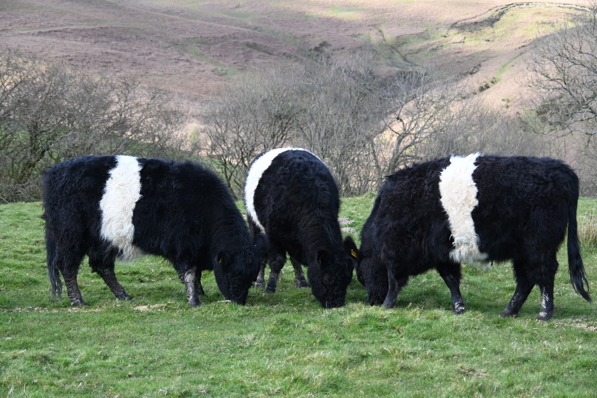
The cattle are Welsh Blacks and Belted Galloways that graze on Radnorshire Wildlife Trust land. “They have a great life,” says Robbie. “The only time we have to handle them is for TB testing.” Ironically, it was bovine TB that resulted in the involuntary decision to phase out the suckler herd of Continental breeds – the farm had a bovine TB breakdown in January 2026, the first Robbie can ever recall, and numbers are already much diminished.
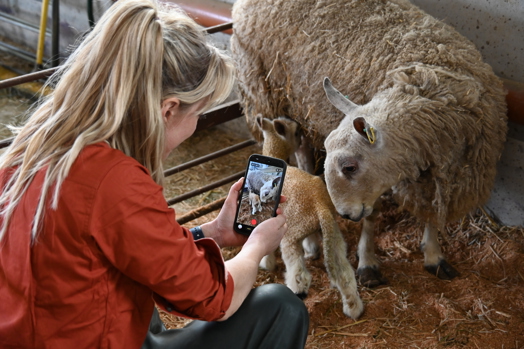
It is challenges like these that connect farmers who can often feel isolated with a sense that they are alone in facing these worries. Social media posts from others facing similar issues can help, a reason why Robbie posts videos on Instagram.
Farrming in mind
While many farmers are active on social media to connect with their consumer, for Robbie it is farmers she has in mind.
“If the weather has been horrendous during lambing and you are having a really tough time it can feel overwhelming, but if you see other farmers posting and know that there are others going through it too, it can help.
“As farmers we perhaps don’t like to admit, to share that we are experiencing lamb losses, for example, but when you see other people in other parts of the country in the same boat it does make you realise that you are not alone, that we can all have rough times and, all being well, that those times will pass.”
Farmers never stop learning either, says Robbie – she sees social media as a good vehicle for improving knowledge.
“A lot of people have farmed all their lives but none of us knows everything, we never stop learning, you can always learn from someone else. “That’s another reason why I post videos, I have a lot of farmers commenting that something they have seen is good and they are going to give it a go, or ask me questions about something they have seen in a post, all those things are useful.”
Honoured and humbled
As a farmer, Robbie never set out to be a role model for women who might be contemplating a career in agriculture, but as the 2025 NFU Cymru/ NFU Mutual Wales Woman Farmer of the Year she is that by default.
Nearly a year on from receiving that award she still feels humbled. “It was a real honour, very humbling, and something I can always be very proud of.
“If it can just encourage any young women who might be offered the opportunity to farm but are questioning if they could do it, if it gives them the inclination to say ‘well I can because there are others out there doing it', then that makes me very happy.”
The next generation
A hunger to farm is already evident in Robbie and Dale’s own teenagers, Joey and Jake, who both hope to carve out their own careers in the industry. While a formal education in agriculture is important, they are also acquiring skills filtered down through the generations.
“Roy is a very clever bloke, he built all the sheds on the farm, tinkers about with all the machinery and fi xes them,” says Robbie. “Joey is studying agricultural engineering at Reaseheath, doing a bit of welding there.
He is in the process of repairing a trailer for Roy in Roy’s welding shed, I’m hoping he and Jake will pick up a lot from their granddad.” With both young men firmly set on pursuing careers in agriculture, the family’s uninterrupted connection to the land looks all but assured.