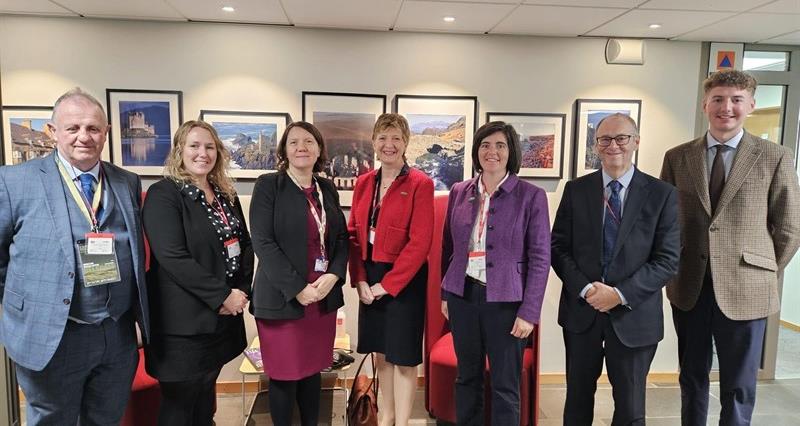
It was a hugely valuable opportunity to meet fellow European farming leaders and understand what’s happening beyond our own borders. Alongside visiting the British Embassy, we held bilateral meetings with farming unions from Norway, Germany, Spain, Finland, Sweden and Denmark. There were some fascinating differences, but also some striking similarities.
Serious about food security
Norway takes food security seriously, despite being only 40% self-sufficient. Its government sets prices for key agricultural commodities (dairy, eggs, wheat and beef) and uses tariffs to protect domestic production.
Spain, meanwhile, is battling severe drought and fighting to protect its agricultural support budget, while Finland is concerned about the power of two supermarkets controlling 80% of its food retail market. Germany is grappling with regulation, farm profitability and attracting the next generation.
Denmark provided perhaps the starkest example of the tension between environmental ambition and food production. Nitrate restrictions are limiting what farmers can grow, while plans to rewet 140k ha peatland, plant 250k ha trees and reduce livestock emissions are creating considerable uncertainty about the future of farming.
They specifically talked about their need for methane reducing products like Bovear to protect their livestock numbers. Meanwhile, Sweden’s farming union made a point that really resonated: Europe cannot expect farmers to guarantee food security if it cannot guarantee their economic security.
‘What keeps your farmers awake at night?’
A question I asked each country is ‘What keeps your farmers awake at night?’. Much like here in Wales: rising input costs, poor farmgate prices, regulation, extreme weather, disease, predators (bears, wolves, eagles, beavers) and uncertainty about the future. There is also growing concern about persuading the next generation to take on farming businesses. Across Europe, farmers are being asked to deliver more, often with less certainty about their ability to make a living.
There were important discussions about the proposed UK-EU Sanitary and Phytosanitary (SPS) deal too. Germany and Finland were supportive of our ambitions, with Germany particularly welcoming UK involvement in future assessment processes for plant protection products, because they felt we were efficient. Sweden also supports the UK having a seat at the table when decisions are made. That matters - we cannot afford to have decisions affecting our industry made without our input.
So, what does this mean for Welsh farmers?
Our European relationships matter. The SPS deal could help restore some of the trade lost following Brexit, BUT we must ensure Welsh farming has a voice in how it works. The UK Government needs to ensure it consults on all details with devolved countries; we are not a side show.
We also have much to learn from our neighbours about protecting domestic food production, securing fair returns and ensuring environmental ambition goes hand in hand with profitable farming. Different countries, different challenges, but one common message: Europe, and the UK, needs viable farmers if it wants a secure food future.