I was delighted to speak at the Vets Northern Ireland conference alongside vet Ifan Lloyd, Director of Iechyd Da, presenting on the Pembrokeshire Project and sharing our experiences. A huge thank you to the organisers for their invitation and hospitality. It was a valuable opportunity to exchange experiences with vets dealing with the same challenges.
DAERA Shared Island Project
A particular highlight was visiting the DAERA Shared Island Project, a five-year, cross-border initiative between the Northern Ireland and Irish governments, covering an area of north-west Northern Ireland and north-east Donegal. With funding from both governments, it is testing a regional approach to tackling TB through coordinated action on wildlife, cattle and farm biosecurity.
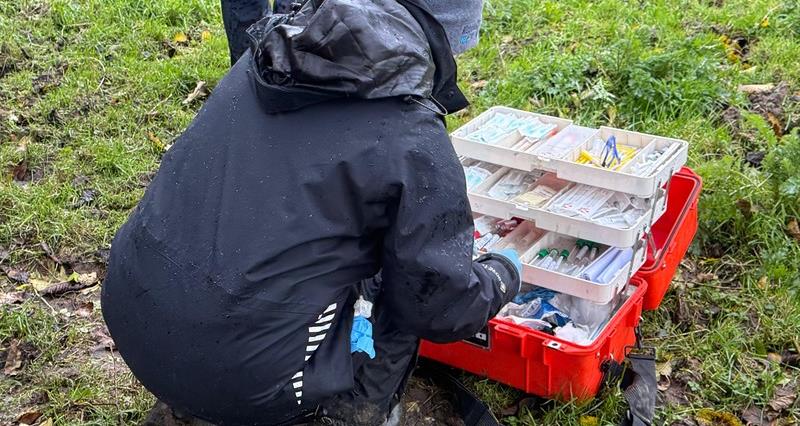
The wildlife element uses a Test, Vaccinate or Remove (TVR) approach. Badgers are systematically trapped, sedated and tested for TB. Those testing positive are humanely euthanised, while negative animals are vaccinated, microchipped and released.
Scale of operation
The scale is remarkable. Around 400 specialist cages, costing approximately £400 each and largely sourced from England, are being deployed. The combined area they are covering is 485km squared. On the Northern Ireland side, they have a number of teams made up of seven or eight people. Each team covers an area of around 10 square kilometres, surveying land, locating setts and placing 10–15 cages per 100 acres.
The operation follows a three-week cycle: surveying (week 1), pre-baiting (week 2) and then setting traps (week 3). Around 20 badgers are being caught each week, although numbers vary considerably. Every animal is sedated and a blood sample taken for the TB test.
The test takes approximately 15 minutes to run so whilst this happens, they also weigh (the ones I saw were 10kg!!), measure, microchip, mark and take hair samples from them. All information is uploaded through a GPS-based recording system. Positive badgers are euthanised and sent for post-mortem examination. Negative ones are vaccinated and released.
Interesting infection picture
The infection picture is particularly interesting. Results have varied dramatically between areas, with some weeks seeing very high proportions of positive animals and others very few. There is not yet an obvious correlation with cattle TB hotspots, but more information will be shared in the coming months.
Importantly, this isn’t simply about badgers. Farmers are receiving biosecurity support, cattle in the area face six-monthly testing, and enhanced gamma testing is being used in eligible breakdown herds. Farmer engagement has been exceptionally strong, with only around 2% reportedly not participating.
So, what does this mean for Wales?
With the new Welsh Government committed to wildlife intervention, I wanted to understand what delivery might actually look like if a similar approach were introduced here. The practicalities are considerable: specialist equipment, trained teams, veterinary capacity, laboratory testing, funding and, crucially, farmer and public engagement.
There are no easy answers, and we must follow the evidence. But one thing is clear: wildlife intervention cannot be considered in isolation. We need a comprehensive approach tackling infection in cattle and wildlife, alongside effective farm biosecurity.
Welsh farmers deserve action that delivers measurable progress. We should be learning from every initiative that has the potential to help us finally get on top of this devastating disease.