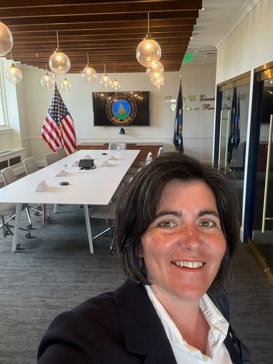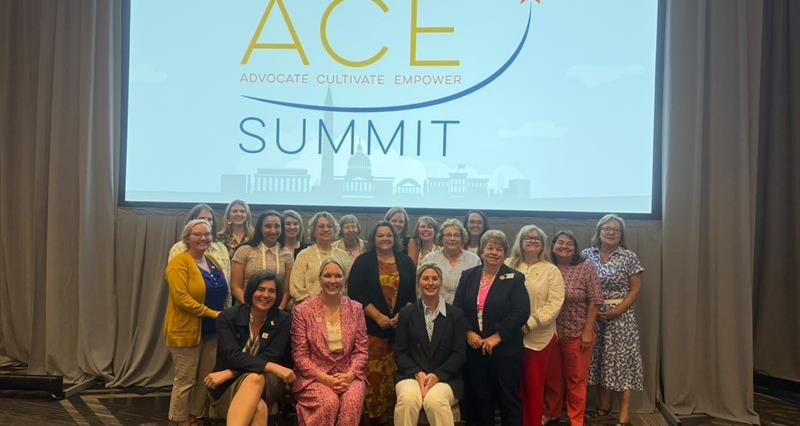
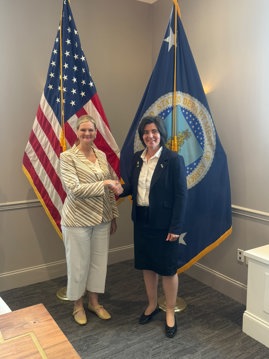
Earlier this summer, I had the privilege of travelling to Washington DC following an invitation from the National Association of State Departments of Agriculture (NASDA) to speak at a conference celebrating the International Year of the Woman Farmer.
Although the trip lasted little more than 72 hours, it provided a valuable opportunity to represent Welsh agriculture on an international stage, build relationships and gain insights into some of the issues shaping farming across the globe.
NFU Cymru's network
Ahead of the visit, I was able to make use of NFU Cymru’s extensive network of contacts. Through the British Embassy, I connected with agricultural officials and policymakers, as well as two Welsh Government officials based in North America, one of whom came to support me in my panel session at the conference.
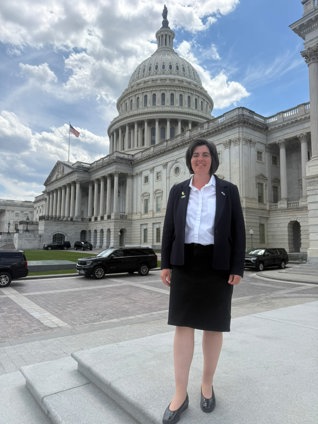
In addition our links with the Brussels office enabled me to meet delegates from COPA who were also attending the conference. Alongside the conference itself, I arranged a number of meetings on Capitol Hill to discuss agriculture, trade and the challenges facing farmers on both sides of the Atlantic.
I particularly enjoyed discussing beef, fuel and fertiliser with Zippy Duvall, President of the American Farm Bureau - the major US farm union with over five million members. Overall, the experience reinforced something I have long believed: while farming systems may differ from country to country, many of the challenges and opportunities facing farmers are remarkably similar.
Women, leadership and agriculture
The main purpose of the visit was the ACE Summit – Activate, Cultivate and Empower 2026. The event brought together farmers, industry leaders and policymakers from around the world to discuss leadership, communication and the future of agriculture.
One statistic that stayed with me throughout the conference was that women are responsible for producing around half of the world’s food. It is a remarkable contribution, yet in many countries women remain underrepresented in agricultural leadership positions.
Here in Wales, we have made significant progress in recent years. Increasingly, our farming organisations, representative bodies and leadership structures better reflect the diversity of the people working within the industry. That progress should be recognised and celebrated.
At the same time, the conference served as a reminder that there is still work to do, not just in Wales but globally. The objective is not about creating opportunities for one group at the expense of another. It is about ensuring that agriculture benefits from the skills, knowledge and leadership potential of everyone involved in the industry.
A recurring theme throughout the summit was confidence. Several speakers highlighted research suggesting that women are often less likely to put themselves forward for leadership roles or opportunities, even when they possess the necessary skills and experience. Confidence, however, grows through participation. The more we engage in discussions, contribute ideas and share experiences, the more comfortable we become in leadership positions.
The conversation resonated with me because it applies far beyond gender. Many people involved in agriculture can be reluctant to step forward, whether that means standing for committees, speaking at events or taking on leadership responsibilities. Yet our industry needs voices from across farming if we are to influence decisions that affect our future.
The summit also highlighted some of the challenges women continue to face in other parts of the world. Access to land ownership, finance, education and technology remains unequal in many countries. In some regions, women can spend their entire lives farming land that they will never have the opportunity to own.
These discussions inevitably led to broader conversations about succession, career opportunities and retaining talent within agriculture. If we want farming to thrive in the future, we need to understand not only why people choose to enter the industry, but also why some decide not to stay.
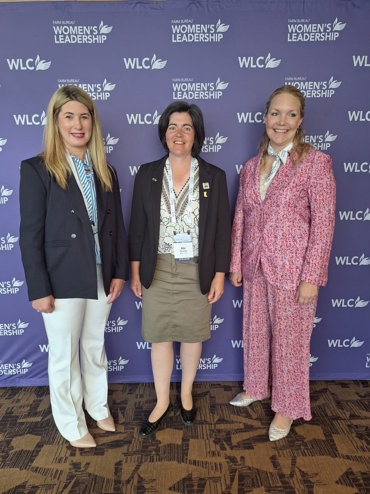
One of the strongest messages from the event was the importance of visible role models. Successful women farmers are not difficult to find. In many cases, they simply prefer to focus on the job rather than seek the spotlight. Yet sharing those stories matters.
When young people can see people like themselves succeeding in agriculture, it broadens their perception of what is possible.
A phrase from one young farmer captured the mood of the conference perfectly: “The future of agriculture will not be written without women. It never was, and it never will be.”
The importance of telling our story
Beyond leadership, one of the major themes of the ACE Summit was communication.
Research presented during the event suggested that public trust in farmers increases significantly when people have direct contact with those who produce their food. While that may not come as a surprise to many of us, it serves as an important reminder of the value of engaging with the public.
Initiatives such as Open Farm Sunday, Welsh Farming Week and our agricultural shows provide invaluable opportunities for people to see modern farming for themselves. They allow us to explain what we do, why we do it and the challenges we face. Watching families ask questions, children engage with livestock and visitors gain a better understanding of food production reinforced exactly the message being discussed in Washington.
The public’s perception of farming is often shaped by headlines, social media or second-hand information. Direct conversations can cut through misconceptions far more effectively than any report or advertising campaign.
We should never underestimate the value of inviting people onto our farms. Whether they are consumers, journalists, politicians or policymakers, farm visits help build understanding and create lasting impressions.
The same principle applies online. Not every farmer needs to become a social media influencer, but every conversation, photograph and post contributes to a wider picture of agriculture. Collectively, these small interactions help tell the story of Welsh farming and demonstrate the care, professionalism and commitment that underpin food production.
Trade and market access
Trade was another major topic throughout my visit.
The United States continues to place significant emphasis on expanding overseas market opportunities for its farmers and food producers. While tariffs often dominate media coverage, many of the conversations I encountered focused on so-called non-tariff barriers.
These are the rules, regulations, certification requirements and administrative processes that can make international trade difficult even when tariffs are low or non-existent.
The European Union continues to be viewed by many within US agriculture as a challenging trading partner, with regulatory differences frequently cited as obstacles to greater trade flows.
For Welsh farmers, these conversations are highly relevant.
Future trade negotiations are increasingly about much more than tariffs alone. Animal health requirements, certification systems, traceability, production standards and regulatory alignment are all becoming critical components of market access.
Wales has a strong story to tell in this regard. Our reputation for quality, high animal health standards, traceability and sustainable production provides a solid foundation for exporting premium products to overseas markets.
However, maintaining access to those markets will require continued engagement and relationship-building. That is why opportunities to represent Welsh agriculture internationally remain so important.
The return of the new world screwworm
One issue that repeatedly surfaced during meetings and discussions was the reemergence of New World screwworm.
This parasitic fly was successfully eradicated from the United States during the 1960s through an innovative programme that involved releasing sterile male flies. Because female flies mate only once, breeding with a sterile male prevented reproduction, gradually eliminating the population.
The programme was regarded as one of the great success stories of livestock disease and pest control. Over time, the pest was pushed south through Mexico and eventually eradicated there as well.
Unfortunately, it is now moving north again. The fly lays eggs in wounds, including the navels of newborn livestock, and the resulting larvae feed on living tissue. Livestock, wildlife, pets and even humans can be affected.
In response, the United States is significantly expanding production of sterile flies, increasing output from around 100 million per week to a planned 300 million per week by the end of 2026.
At the same time, restrictions on cattle movements from Mexico have become a source of frustration for some farmers who rely on imported cattle for feedlots.
Listening to the debate, I was struck by how familiar some of the arguments sounded.
Much like our own experiences with bluetongue, questions are being asked about the effectiveness of movement controls when the disease itself is spread by a flying insect.
Regulators argue that while insects spread naturally, human activity can move infected animals much further and much faster, increasing the risk of wider outbreaks.
As one official put it during discussions, this is as much a people problem as it is an animal problem.
Looking ahead
Although brief, the visit provided a valuable opportunity to promote Welsh agriculture, build relationships and learn from colleagues across the world.
Whether discussing leadership, communication, trade or animal health, the conversations reinforced the importance of ensuring that Welsh farmers remain engaged, visible and influential in shaping the future of our industry.
Agriculture is increasingly interconnected. Decisions made in Washington, Brussels or elsewhere can have implications for farmers here in Wales. Equally, Wales has a great deal to contribute to global conversations about food production, sustainability and rural communities.
I returned home proud to have represented NFU Cymru and Welsh agriculture, and encouraged by the opportunities that exist when farmers take the time to share their experiences, build relationships and tell their story.