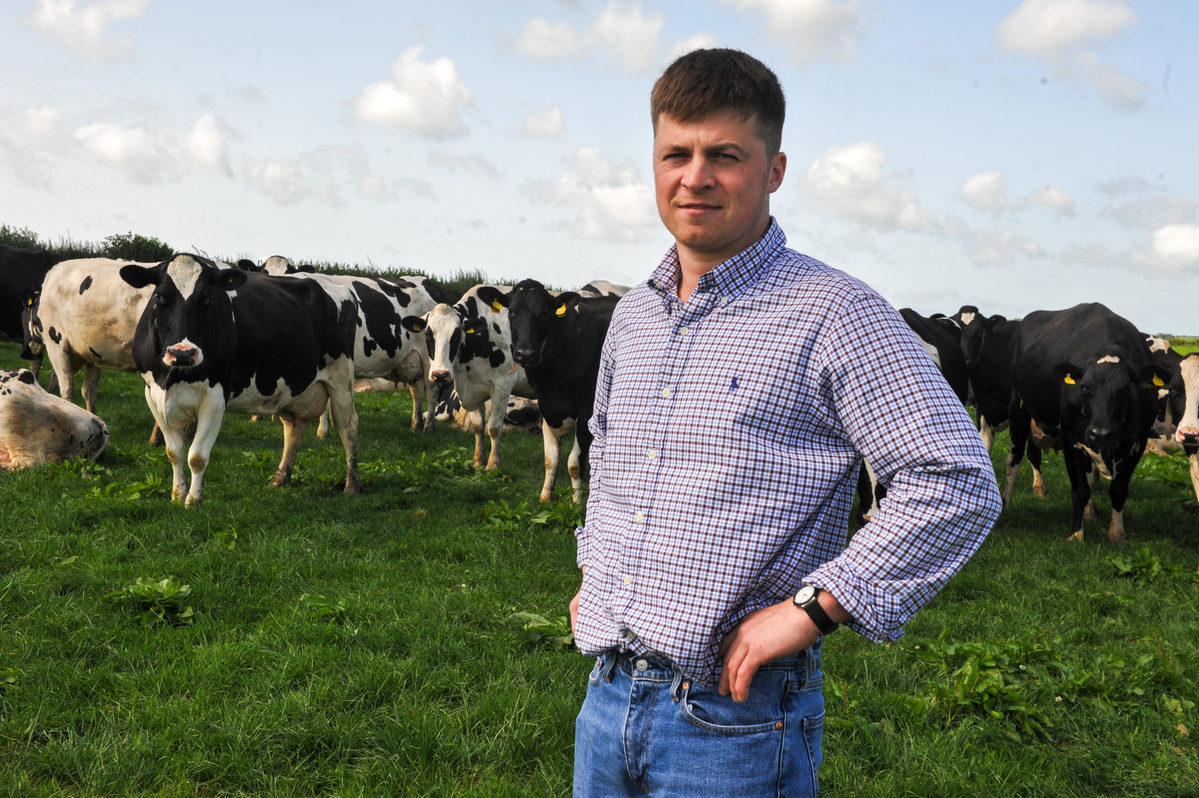
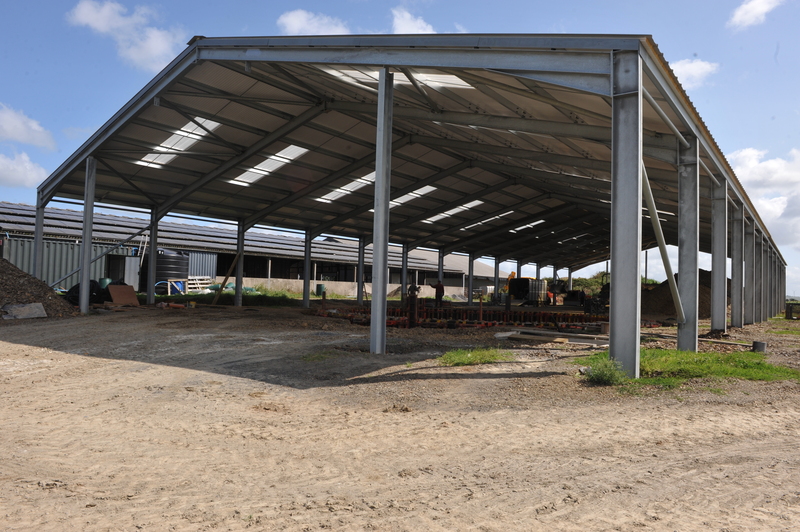
The farmyard at Ffynnonbrodyr is a hive of activity with workmen busy constructing the shed that will house the farm’s new milking parlour.
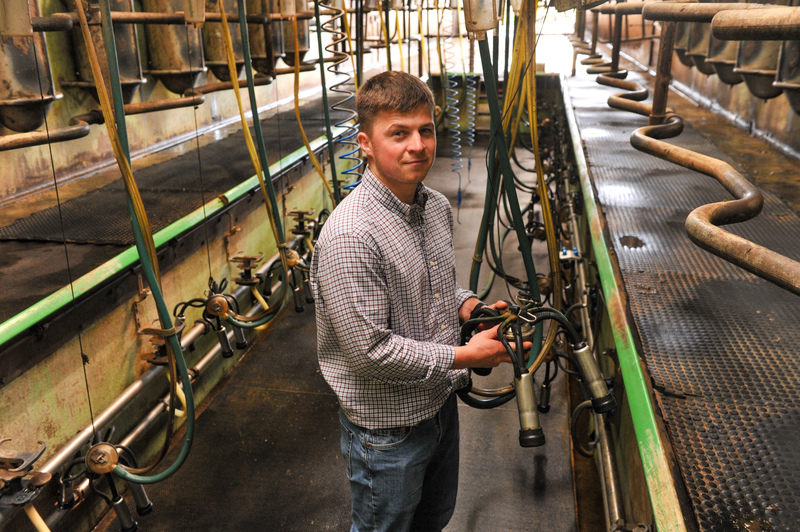
When the 50-point rotary is operational next spring, daily milking times will be significantly less than the nine hours it takes in the existing 10-aside herringbone.
"It will change my life," laughs William, whose alarm is mostly set for 4.15am for the morning milking shift, which he shares with a full-time worker and two relief milkers.
William farms with his parents, Rhys and Mary, and together they have made significant advances in lifting milk yields and solids in recent years.
Genomics, breeding and changes to herd management and nutrition has seen annual yield per cow increase from 9,000 litres to 10,700 litres at 4.4% butterfat and 3.6% protein.
Ambition
William has further ambition on this. “We are achieving just over 850kg milk solids a year but in the coming years the aim is to get to 900kg from a twice-a-day milking routine.”
Among his strategies to achieve this is to introduce stronger heifers into the herd, focussing on rearing protocols from the baby calf stage to first calving.
"If you get heifers right and from the right genetics they will outperform good cows," says William.
This, in combination with the new parlour and improvements to feed quality through multi-cut silaging and upgrades to the ensiling clamp, will enable the business to increase production without growing herd size.
"We could grow the herd but by doing so we would be locking ourselves up on nitrogen loading," says William, referencing the Wales-wide.
Control of Agricultural Pollution Regulations.
Efficiency
"It would be nice to expand the herd to a point but our goal is to make what we do manageable with maximum labour efficiency."
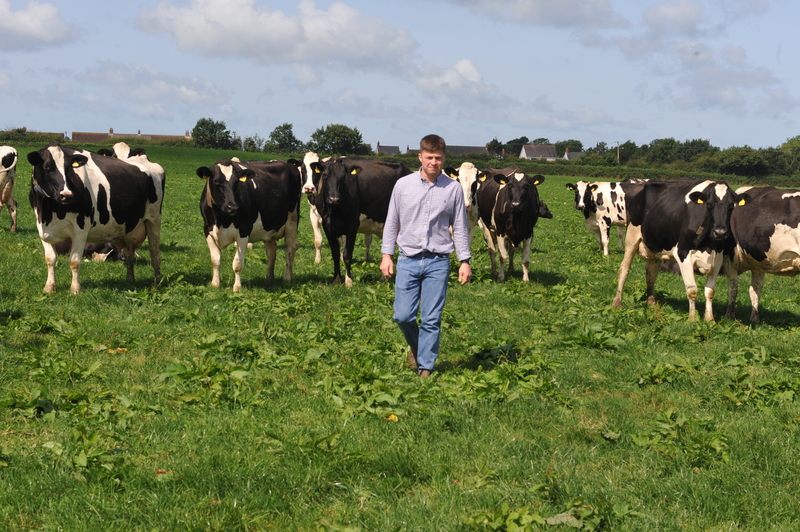
The all-year-round calving Holstein Friesian herd numbers 350 cows with around 300 in milk at any one time.
Ffynnonbrodyr is where Mary grew up and where her parents produced beef and arable crops.
When Mary married dairy farmer Rhys, from Templeton they made the decision to concentrate on milk production at Ffynnonbrodyr, with the couple establishing a partnership with Mary’s parents in 1994.
William, now 28, joined them on the farm after studying agriculture at Gelli Aur College and Harper Adams University.
Arable
The family farms 700 acres, growing 100 acres of maize, 300 acres of silage harvested four times a year, and 50 acres of winter wheat.
These crops form the basis of the Total Mixed Ration (TMR) together with a blend and caustic wheat.
From the beginning of May until late September, cows are turned out to grass after the morning milking then buffer-fed and housed at night.
During the grazing season, the projected intakes of 35kg of grazed grass per cow is deducted from the grass silage element of the buffering ration. "We try to match it to what the cows would get in the winter," William explains.
It is this shift from a system of the herd being fully at grass during the grazing season that has in part improved milk quality. "We used to see a big drop in butterfat at turnout," William recalls.
But gains overall are also coming from genomically sampling heifer calves.
Herd blueprint
This has given the Davieses a blueprint of their herd traits, enabling them to select sires that meet that requirement.
protein and milk yield needs of their milk supply contract with First Milk.
"We have got cows now that were born as calves when I first came home to farm that have really helped to jump the herd average in the last couple of years," says William.
"Heifers are producing a lot of solids for their size which is very pleasing. Genomics gives us the potential and then it’s up to us to succeed with that."
Mature cow size is 650-700kg with cows in the herd for an average of four lactations. Breeding for smaller cows means they are more durable, William has observed.
Sexed semen is used for up to three cycles and Aberdeen Angus beef genetics are used on the lower performing animals.
Newborn calves receive six litres of colostrum within their first 24 hours and are grouped in pens of six to eight calves for the first week.
The beef calves are then sold to ABP on a Blade Gamechanger contract and the heifers transferred as groups of four to hutches, where they are reared until they are up to 10-weeks-old.
At weaning calves receive 3kg of concentrates and ad lib hay and straw for 10 months before they are introduced to a TMR to achieve a target bulling weight of 380-400kg to calve at an average of 25 months. The aim is to reduce age at first calving.
"We have gone from rearing everything to only rearing dairy replacements so we have got more space and that means we can make a better job of rearing," says William.
"In the next year or so I would like to think that we would be calving heifers at under 24 months."
Three years ago improvements were made to the forage clamps. Before then silage was stored in one big pit but investment in A-walls means that storage can be much tidier and wastage reduced.
"If you have a big mound of forage it makes the shoulders on the clamp big and you lose a lot of feed with that," says William.
Silage
Silage is cut from the end of April with a target to take the last cut no later than mid-September, all harvested by contractors.
For the last two years the high starch maize variety, Pasco, has been grown.
Attention to detail is applied to all aspects of the business, in particular livestock matters from management to health and production.
It was one of the stand-out features that saw William awarded the 2024 NFU Cymru/NFU Mutual Dairy Stockperson of the Year Award at last year's Welsh Dairy Show at Carmarthen.
He never compromises on his meticulous approach with stock, such as spotting sick cows and treating them there and then. "We are stock people here," he says.
Winning the award meant a lot to him. "It was nice to get some recognition, and even though it was me who won it, a lot of hard work had gone on before I even came home. My parents have had a big influence."
Rhys and Mary also have a daughter, Emily, a nurse at Glangwili Hospital.
When he is not busy on the farm, William plays rugby for Narberth RFC as a centre in its Second XV.
Having a good work-life balance is important he says, although he admits that, as a farmer, that goal is not always easy to achieve.
But on the farm, making the work as sociable as possible and the working environment easier, adds enjoyment to the job.
"We are spending money now to make things easier, a lot of the decisions are based on simplifying jobs."
With those investments in place, that sometimes elusive work-life balance could just be within grasp.
They currently select bulls to match the butterfat