Our policy team have analysed the details for the SFS to provide shorter guidance for farmers wanting to learn more about the scheme. For full scheme details please visit the Welsh Government website.
Use these quick links to jump to information on:
- Scheme structure
- Scheme eligibility
- Common land
- SFS map
- 10% habitat requirement
- Universal Actions
- UA1 Soil Health
- UA2 Integrated Pest Management
- UA3 Benchmarking
- UA4 Continuous Professional Development (CPD)
- UA5 Habitat Maintenance
- UA6 Temporary habitat creation on improved land
- UA7 Designated Site Management Plan
- UA8 Hedgerow Management
- UA9 Woodland Maintenance
- UA10 Tree and Hedgerow Planting Opportunity Plan
- UA11 Historic Environment
- UA12 Animal Health and Welfare
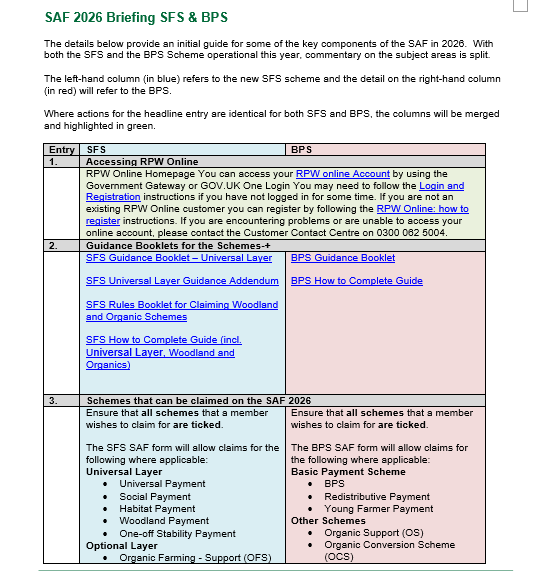
- SFS - Universal Layer payments
- Basic Payment Scheme
- Summary of key dates
- SFS one page briefing
The SFS – Universal Layer will start on 1 January 2026 and the transition from the Basic Payment Scheme (BPS) will take place over the next three years, with a 40% reduction in 2026. Farmers will have the choice between joining the SFS or remaining in the legacy BPS. The Ready Reckoner on the Welsh Government website provides an indicative SFS Universal Payment value for 2026.
The SFS 2026 Map detailing the broad habitat classifications, woodland and tree canopy cover, designated sites and historic features on your farm, is available on Rural Payments Wales (RPW) Online.
Checking your details are up to date
It’s worth checking to ensure your business and land details are up to date. If you have acquired additional land this could have an impact on your habitat and woodland cover. For any changes, the RPW Manage My Land form is available.
It’s also worth familiarising yourself with the scheme requirements as set out in SFS – Universal Layer Guidance 2026 booklet and Welsh Government highlights that you can get a head start on some of the individual Universal Actions, as follows:
- UA1 Soil health: Soil testing undertaken up to four years before you enter the Scheme will count towards this UA
- UA4 Continuous Professional Development: SFS e-learning modules available from Farming Connect and completed in 2025 will count towards this UA for 2026
- UA10 Tree and Hedgerow Planting Opportunity Plan: Consider where additional tree and hedgerow planting would be beneficial to your farm. Consider planting now through existing woodland and hedgerow creation schemes
- start to familiarise yourself with the templates available to make certain UAs easier. Such as UA2 Integrated Pest Management and UA12 Animal Health and Welfare
Applying for the scheme
To apply for the Universal Layer, you will need to submit a claim on the SAF by 15 May 2026. The SAF will be available on 2 March 2026. When you start the completion of the SAF, you will need to make a choice between SFS and BPS.
The transition to SFS is going to be a significant change for farmers. Further advice and guidance is available via the RPW – Customer Contact Centre on 0300 062 5004. The Farm Liaison Service (FLS) is also available to provide support and Farming Connect on 03456 000 813 also has a range of resources and information available.
Universal Layer: Guidance 2026
In December, Welsh Government (WG) published guidance on the Sustainable Farming Scheme for 2026. The guidance explains:
- the SFS Scheme requirements,
- Universal Actions,
- Single Application Form (SAF) and the SFS dashboard,
- Evidence and on-farm records requirements.
This article provides a summary of the Welsh Government 224-page document.
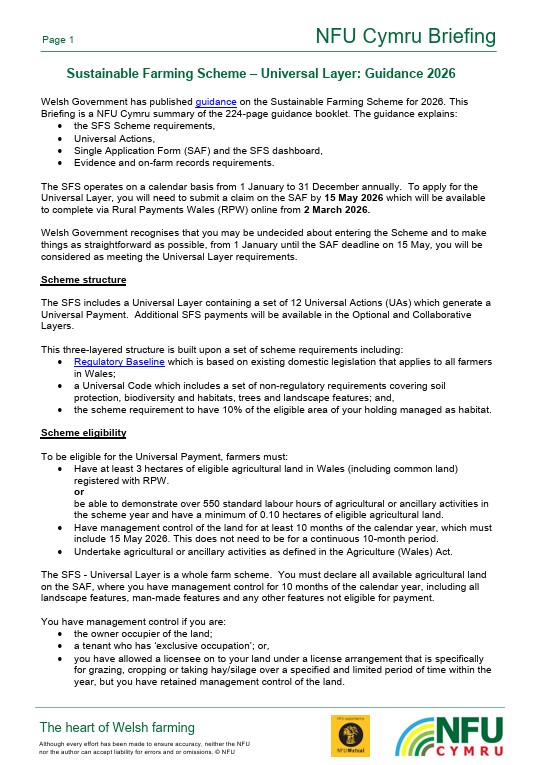
The SFS operates on a calendar basis from 1 January to 31 December annually. To apply for the Universal Layer, you will need to submit a claim on the SAF by 15 May 2026 which will be available to complete via Rural Payments Wales (RPW) online from 2 March 2026.
Welsh Government recognises that you may be undecided about entering the Scheme and to make things as straightforward as possible, from 1 January until the SAF deadline on 15 May, you will be considered as meeting the Universal Layer requirements.
The RPW Customer Contact Centre and the Farm Liaison Service (FLS) are available to assist with scheme related queries.
Scheme structure
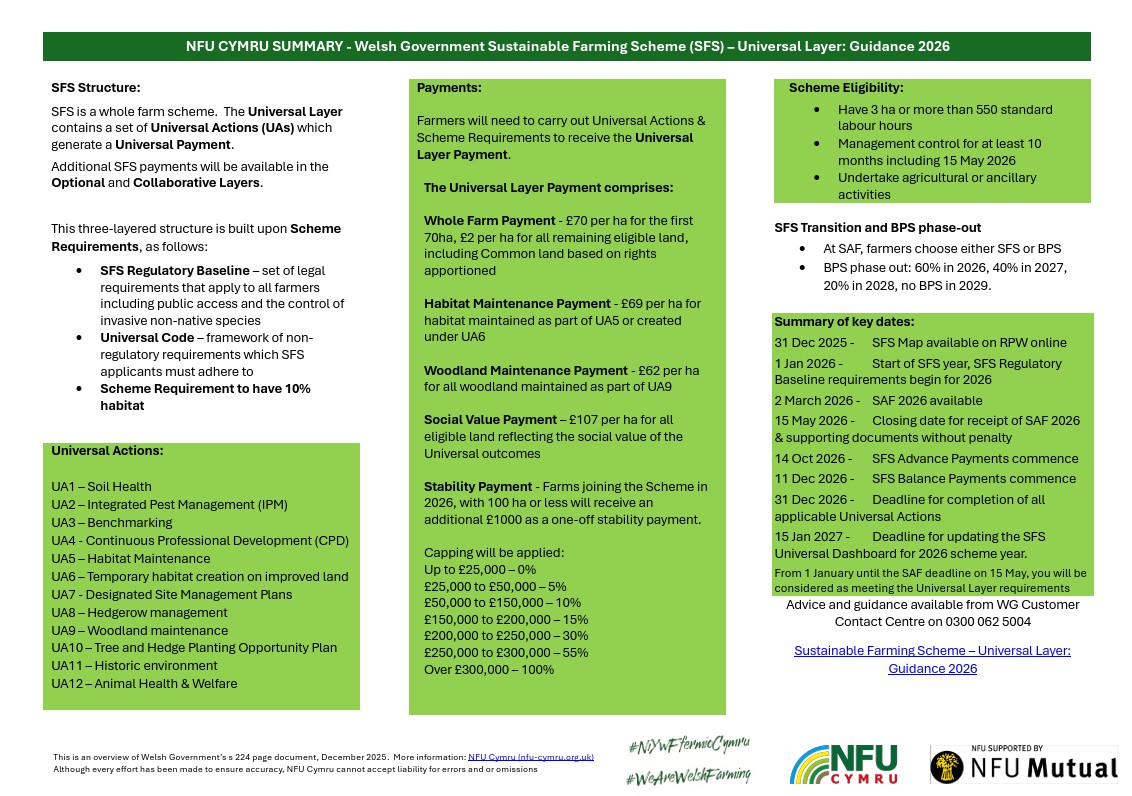
The SFS is a whole farm scheme. It includes a Universal Layer containing a set of 12 Universal Actions (UAs) which generate a Universal Payment. Additional SFS payments will be available in the Optional and Collaborative Layers.
This three-layered structure is built upon a set of scheme requirements including the Regulatory Baseline which is based on existing domestic legislation that applies to all farmers in Wales; a Universal Code which includes a set of non-regulatory requirements covering soil protection, biodiversity and habitats, trees and landscape features; and, the scheme requirement to have 10% of the eligible area of your holding managed as habitat.
Scheme eligibility
To be eligible for the Universal Payment, farmers must:
- Have at least 3 hectares of eligible agricultural land in Wales (including common land) registered with RPW.
or
be able to demonstrate over 550 standard labour hours of agricultural or ancillary activities in the scheme year and have a minimum of 0.10 hectares of eligible agricultural land. - Have management control of the land for at least 10 months of the calendar year, which must include 15 May 2026.
- Undertake agricultural or ancillary activities as defined in the Agriculture (Wales) Act.
The SFS - Universal Layer is a whole farm scheme. You must declare all available Welsh agricultural land on the SAF, where you have management control for 10 months of the calendar year, including all landscape features, man-made features and any other features not eligible for payment.
You have management control if you are the owner occupier of the land; a tenant who has ‘exclusive occupation’; or, you have allowed a licensee on to your land under a license arrangement that is specifically for grazing, cropping or taking hay/silage over a specified and limited period of time within the year, but you have retained management control of the land.
Welsh Government advises you do not need to have management control of the land for a continuous 10-month period.
An initial derogation from the 10-month rule is available where you have taken on land under the terms of a new tenancy of three years or longer, which began after 28 February 2026 but before 15 May 2026.
Common land
Common land grazing rights can be used to form part of your Universal Payment. Welsh Government will apportion and allocate an area of the common land to you and include the apportioned common land area for the Whole Farm Area Payment within the Universal Baseline Payment and the Social Value Payment.
SFS Map
Welsh Government will make an SFS map detailing the broad habitat classifications, woodland and tree canopy, designated sites and historic features available on your RPW online account from 31 December 2025. You will need to review the map before submitting your claim on the SAF 2026. The map can be used to estimate your 10% habitat requirements and plan future actions for temporary habitat, if applicable.
10% Habitat Requirement
The total areas of the following will be used to determine the 10% habitat requirement, in the order set out below:
- All semi-natural habitat as defined under UA5: Habitat Maintenance. These areas will be shown on the SFS Map and you will have the opportunity to amend, confirm and declare all areas of semi-natural habitat in the Habitat Baseline Review on the SAF 2026.
- Establish broadleaved woodland. These are areas of tree canopy or woodland of 0.1ha or more. These areas will be shown on the SFS Map and include areas of broadleaf woodland established up until the point the SAF 2026 is submitted. Broadleaf means more than 80% of the area is made up of broadleaf trees.
- Hedges restored or created since 1 April 2022 under the Glastir Advanced, Glastir Small Grants or Small Grants – Environment schemes. These hedges do not need to meet the definition of hedgerows in ‘good condition’.
- Hedgerows in ‘good condition’ (see below).
- Temporary Habitat under UA6. If you do not meet the 10% threshold from semi-natural habitat, woodland areas and hedgerows you will need to create temporary habitat in accordance with UA6: Temporary habitat creation on improved land.
Areas of apportioned common land (except for sole grazier common), and shared grazing land will not be used or included to calculate the 10% habitat requirement.
Hedgerows in ‘good condition’ must meet the following criteria to be included for the 10% habitat requirement:
- Be a mix of woody shrubs that provide significant value for biodiversity and shaped by trimming.
- Measure at least 3m wide and 2m tall, or 2m wide and 3m tall.
- Be at least 20m in continuous length, measured along a traditional field boundary.
- Gaps must total no more than 5% of the length of the hedgerow.
- Livestock must be prevented from damaging the hedgerow from both sides.
- Where the hedgerow is double fenced, there must be a minimum of 3m between double fences. As a concession, Welsh Government will allow a minimum of 2m between double fences if the fences have been erected under the Glastir Entry scheme from 1 January 2012 or the Glastir Advanced scheme from 1 January 2013.
Universal Actions
Universal Actions must only be completed if they are relevant to your holding. For example, UA2 is not applicable if plant protection products are not used on your land. UA12 is not applicable if you do not have any livestock on your land, for which you are the owner or registered keeper.
UA1 Soil Health
You must complete this Universal Action if you claim on field parcels with improved land. This is land that has been managed to improve agricultural productivity, for example, by reseeding, or that has previously received or may receive lime and/or inputs such as organic and inorganic fertilisers.
You must ensure a minimum of 20% of your fields containing improved land are soil tested by 31 December 2026 for Phosphorus (P), Potassium (K), Magnesium (Mg), pH and Soil Organic Matter (SOM).
Soil testing after 1 January 2022 can count towards this UA. The test results must have included P, K, Mg and pH but does not require a result for SOM. Field parcels will require soil-testing again 5 years from the date of the last test.
Welsh Government will identify your improved land on the SAF. If you have land that has not received inputs since 1 April 2022, and/or will not received inputs and/or lime within the scheme year, you will need to confirm this on the SAF. Those fields will then be removed from the soil testing requirements.
The SFS Universal Dashboard will identify all the individual field parcels that must be soil tested and you must record the soil testing results by 15 January 2027.
UA2 Integrated Pest Management
You must complete this UA if you use, or employ contractors to use, Plant Protection Products (PPP) on any of the land you farm and claim.
You must collect and record data of all PPP used on your holding. There is a Pesticide Treatment Record template available on the Welsh Government website.
You must complete an assessment, by 31 December 2026, of the use of PPP and alternative methods to reduce chemical usage and record this in your Integrated Pest Management Plan. Welsh Government are not specifying which plan should be completed as there are many suitable industry templates available.
To identify whether this UA is applicable to your holding, you must confirm on the SAF 2026 whether or not you use, or intend to use, PPP in 2026. You must confirm on your SFS Universal Dashboard by 15 January 2027 that you have met the requirements of this Universal Action. You are not required to submit records of your PPP use or submit your IPM plan. Records must be completed and kept on farm for a minimum of 5 years and made available at inspection, if requested.
UA3: Benchmarking
By 31 December 2026, all farmers entering the Scheme will need to complete this action by:
- Completing an approved industry or supplier benchmarking tool such as AHDB Farmbench or Farm Business Survey
Or
- Using the benchmarking tool: FARMDATA+ available from 1 April 2026 through Farming Connect.
Welsh Government will not be monitoring or assessing the benchmarking data.
You will be required to confirm which agriculture sectors apply to your business when completing the SAF. You must confirm on your SFS Universal Dashboard by 15 January 2027 that you have met the requirements of this Universal Action. If you are using an approved industry or supplier benchmarking tool you must provide information on the tool used and the date completed. Results should be kept on-farm for a minimum of 5 years. If using FARMDATA+, the titles of the completed KPIs will be automatically shared with RPW and the Dashboard updated.
UA4 Continuous Professional Development (CPD)
You and/or your business partner (s) must complete a minimum of six hours of learning, and a mandatory health and safety training module by 31 December 2026.
The mandatory health and safety training must be completed through Farming Connect, available online. In person support will be made available across Wales for those that require assistance.
SFS related e-learning modules, already completed with Farming Connect from 1 August 2025, will count towards this UA for 2026 only.
You, or a member of your farm business (or a nominated individual), must also complete training for competence in body condition scoring (BCS) and mobility scoring every 5 years. Farming Connect funded animal health and welfare workshops delivered by vet practices or completion of the animal health and welfare e-learning modules can count towards the requirement of UA4 and UA12 if completed by the appropriate person.
You must confirm on your SFS Universal Dashboard by 15 January 2027 that you have met the requirements of this UA. If completed through Farming Connect, the details of the completed learning will be automatically shared with RPW, to update your SFS Universal Dashboard. If the learning has been delivered by an external provider, you must confirm the course title, date of attendance, hours of learning, SLM objectives covered and the name of the individual from the farm business who undertook the learning. Records must be retained for a minimum of 5 years and made available at inspection, if requested.
UA5 Habitat maintenance
- You must complete this UA if you have one or more of the following:
Coastal saltmarsh - Coastal sand dune and shingle beach:
(a) Sand dune
(b) Sand dune and shingle beach - Lowland and coastal heath
- Enclosed wetland and marshy grassland:
(a) Enclosed wetland - lowland bogs, fens and flush / mire
(b) Marshy grassland - Enclosed semi-natural dry grassland:
(a) Managed as grazed pasture
(b) Managed as hay meadow - Upland open habitats
- Traditional orchards
- Dense bracken
- Scrub
- Wood pasture
- Permanent wildlife ponds
- Newly created habitat areas on improved land:
(a) New streamside corridors
(b) Newly restored peat
(c) No input grassland from previous schemes
(d) Any other improved or previously afforested land which is under habitat creation management
The location and extent of each habitat classification will be shown on the SFS Map. You must manage all semi-natural habitats on your holding, in accordance with the relevant habitat classification. There are certain activities which you should keep a record of in an activity diary. You are also required to keep a stocking diary if you have Upland open habitats.
Areas of semi-natural habitat on your holding must be confirmed on the SAF 2026 in the Habitat Baseline Review. You will need to confirm on the SFS Universal Dashboard by 15 January 2027 that you have met the requirements of this Universal Action.
UA6 Temporary habitat creation on improved land
If you do not have sufficient semi-natural habitat, established broadleaf woodland, newly created hedgerows since 1 April 2022, or hedgerows meeting the ‘good condition’ criteria, you must create temporary habitat on improved land to meet the 10% habitat requirement annually.
Areas of temporary habitat created and managed in accordance with this Universal Action will be eligible for the Habitat Maintenance Payment. However, any areas of temporary habitat created above the 10% threshold will not be eligible for the Habitat Maintenance Payment.
You must create sufficient temporary habitat before the end of the scheme year (i.e. by 31 December 2026). You can choose one or more habitats from the following list:
- Fallow crop margins.
- Unfertilised, unsprayed and unharvested cereal and linseed headlands.
- Fixed rough grass margins on arable land.
- Rotational rough grass margins on arable land.
- Unsprayed spring sown cereal and protein crop mix with stubbles retained.
- Retain cereal winter stubbles.
- Wildlife cover crop on improved land.
- Unsprayed, unfertilized and uncultivated buffer adjacent to existing habitat (including open water) on improved grassland.
- Mixed leys on improved land with a closed period (also referred to as multi-species or herbal leys).
- Late cut improved grasslands.
- Improved grassland allowed to set seed.
If you do not meet the 10% habitat requirement, you must declare areas of temporary habitat already created, and/or confirm the areas, location and crop codes of any new temporary habitat that will be created before the end of the scheme year in the Habitat Baseline Review on the SAF 2026. You will need to confirm on the SFS Universal Dashboard by 15 January 2027 that you have met the requirements of this Universal Action. Certain activities should be recorded in an activity diary, kept on farm for a period of 5 years.
UA7: Designated Site Management Plan
This Action is applicable for holdings with part, or all of a designated site such as a SSSI, SPA, SAC, Ramsar Site and NNR). WG will confirm if you have any sites on your holding via the SFS Map.
To complete this Universal Action you will need to work in partnership with Welsh Government and NRW to develop a Designated Site Management Plan and agree a Schedule of Works. This UA must be completed by 31 December 2030.
If you have a management agreement already in place, including a Section 16 agreement with NRW, to may be sufficient to satisfy the requirement for this UA.
Designated sites on your holding will need to be confirmed on the SAF 2026. Where applicable the SFS Universal Dashboard will highlight the need for a Designated Site Management Plan and you will be contacted to begin the process of developing your Management Plan.
UA8: Hedgerow Management
You must complete this UA where you have management control of hedgerows on your holding that are managed by cutting and/or trimming. If you do not cut or trim your hedgerows you do not need to follow these requirements.
- Do not trim or cut the same hedgerow in successive years i.e. do not cut a hedgerow back two years in a row. This does not prohibit the cutting of encroaching bramble outside the hedge profile, if it is for animal health and welfare reasons.
- The following exemptions from this requirement are permitted, where cutting or trimming may be carried out annually as appropriate:
- The hedgerow or hedgerow trees overhang a highway, road, track or footpath and the work is necessary for health and safety reasons.
- The cutting or trimming is carried out as part of wider routine ditch maintenance on improved land.
- The utility company responsible for the maintenance of any overhanging electricity or telephone lines may cut back trees and or hedges for safety reasons.
- Hedge restoration e.g. laying or coppicing may be carried out during March as long as nesting birds are not knowingly disturbed.
- Hedge restoration e.g. laying or coppicing is permitted up to 30 April if specifically for a competition and/or training event, as long as written permission is obtained from Welsh Government in advance of the event.
- You must also not cut or trim hedgerows during the bird nesting season, 1 March to 31 August (exemptions apply – see Universal Code).
- You must allow the hedges to grow thicker and taller by trimming them to a slightly higher and wider point each time they are trimmed or cut. There should be at least 5cm incremental growth between trimming. Once the hedge has reached a width and height of 3m by 2m (or 2m by 3m) you have the choice to retain it at this size through incremental cutting.
- You must maintain or establish at least one hedgerow tree on average for every 50m of hedgerow. You should meet this requirement on a field parcel basis.
You must confirm on the SAF 2026 whether you have management control of any hedgerows on your holding. If you are declaring any of your hedgerows to meet the 10% habitat requirements, you will need to declare the lengths of eligible hedgerows on the SAF. You will need to confirm on the SFS Universal Dashboard that you have met the requirements for this UA.
UA9: Woodland maintenance
You must complete this UA where you have existing woodland on your holding for which you have management control, in individual blocks of 0.1 hectares or greater. It can be broadleaf woodlands, conifer plantation, or a mixture of both. Individual trees or groups of trees smaller than 0.1 hectares should be managed in accordance with the Universal Code.
Areas of woodland managed in accordance with this UA will be eligible for the additional Woodland Maintenance Payment.
You must:
- Follow all legal requirements regarding trees and woodland.
- retain any deadwood present equating to at least 5% of the stand volume (1 in 20 living canopy trees). Felled tree stumps do not count towards this figure. The 5% should include a mix of both standing and fallen deadwood, if present. Deadwood over 5% can be removed.
- monitor the impact of grazing, grey squirrel damage and any deer browsing which can be detrimental to the survival of trees and woodland. If possible, you should avoid grazing woodlands in the spring and early summer.
- retain all existing intentional open spaces within the woodland. Retaining open space requires regularly maintenance to ensure they remain free from trees, this can include cutting. Intentional open space can occupy up to 20% of a woodland block.
- ensure pruning or lopping is undertaken appropriately with a clean cut and does not result in any deterioration in the tree condition.
- encourage natural regeneration by occasionally cutting back plants like bracken or bramble that might suppress young trees.
Do not:
- Breach felling licence requirements.
- Damage native ground flora trees and their roots directly or indirectly. This includes avoiding the following activities:
- No cultivation or ploughing of soil within the root protection area of trees
- No use of agro-chemicals including fertilisers, herbicides and pesticides
- No use of heavy machinery that could cause soil compaction, root disturbance, bark damage
- No trenching, digging or soil stripping near trees
- No storage of materials at the base of trees
- No lighting of fires or burning near trees
- Cut, trim or fell trees during the bird nesting season between 1 March and 31 August (exceptions apply)
- Carry out supplementary feeding within broadleaf woodland. Supplementary feeding may take place in conifer woodlands where required specifically for the welfare of livestock.
- Use Plant Protection Products, except for the purposes of controlling invasive non-native species or managing notifiable tree pests and diseases.
- Use the woodland for unapproved off-road vehicle activities.
- Carry out earth moving activities or construct new tracks, roads, yards, loading bays/stacking areas or any new structures within the woodland, without prior approval.
If you have a valid NRW approved Forest Management Plan, or felling licence, you should continue to manage your woodland in accordance with these requirements.
You must confirm areas of woodland and/or tree canopy over 0.1 hectares on the SAF 2026. You will need to confirm on the SFS Universal Dashboard by 15 January 2027 that you have met the requirements of this UA.
UA10: Tree and Hedgerow Planting Opportunity Plan
For this UA, you will need to complete a Tree and Hedgerow Planting Opportunity Plan on RPW online by 31 December 2026 and demonstrate progress towards implementing your plan by 31 December 2028.
The Tree and Hedgerow Planting Opportunity Plan will be available for you to complete via your RPW Online account from summer 2026. As a minimum, the plan must include at least 0.1 hectares of potential new tree planting. If you include new hedgerow planting in your plan, the minimum length of an individual hedgerow must be 20m.
You must plant a minimum of 0.1 hectares (at a minimum planting density of 2,500 trees/ha) or 250 individual trees which could be in one block or a combination of individual trees, trees in hedgerows and smaller groups of trees by 31 March 2029. New tree planting completed since 1 April 2022 will count towards demonstrating progress towards implementing the plan. Optional support is available for a variety of different planting options.
Once you have completed and submitted your Tree and Hedgerow Planting Opportunity Plan, the SFS Universal Dashboard will be automatically updated. Progress towards implementing your plan and completing the tree planting requirements will be shown from 2027 onwards.
UA11: Historic Environment
This Universal Action applies to farmers with any of the following:
• Scheduled monuments
• Historic Environment Features
• Registered parks and gardens
• Traditional farm buildings
The location and extent of these features will be identified on the SFS Map. WG require farmers to maintain these historic assets in line with a specific set of requirements. You will need to confirm on the SFS Universal Dashboard by 15 January 2027 that you have met the requirements of this Universal Action. The evidence and/or activity diary should be kept on farm for a minimum of 5 years and made available at inspection if requested.
UA12: Animal Health and Welfare
You will need to complete this UA if you are the owner or registered keeper of livestock, where they are reared or farmed to produce food or goods.
There are three distinct elements of this UA:
- Animal Health Improvement Cycle (AHIC)
- Incoming Animal Biosecurity Risk Assessment
- Animal welfare
Animal Health Improvement Cycle (AHIC):
The AHIC process includes four steps as follows:
- Measure – identify with your vet at least one relevant livestock health and production metric which you agree could be improved.
- Plan – Working with your vet, set out and agree an action plan (usually two to four actions) for each metric you want to improve.
- Act – Carry out and record a manageable number of measurable actions for each metric, to achieve improvements.
- Review – With your vet, analyse the impacts of the actions that have been made and assess whether these have met the desired targets. Identify further areas for improvement once the targets are met. The results of this process do not impact the Universal Payment.
The AHIC steps should be completed on a rolling 12-month cycle with steps 1 & 2 completed by 31 December 2026 and steps 3 & 4 completed within 12 months from when you signed off the measure step so that by 31 December 2027 you will have completed the full AHIC and repeated steps 1 & 2 again for the 2027 scheme year.
The AHIC should be delivered by the local veterinary practice responsible for prescription medicines and with your animals under their care. The AHIC only needs to be completed for one livestock species.
The AHIC template available on the Welsh Government website must be completed and signed by both your vet and an appropriate member of your farm business.
Welsh Government states that farm assurance schemes provide a solid foundation on which the AHIC process can complement and enhance animal health and welfare planning processes already established.
Biosecurity assessment for incoming animals:
An Income Animal Biosecurity Risk Assessment must be completed by 31 December 2026. This must be signed by both your vet and an appropriate member of your farm business. You must use the templates available on the Welsh Government website. Where you have multiple livestock species, the Risk Assessment should be completed for one livestock species which you and your vet assess is the most appropriate.
Animal welfare:
You, or a member of your farm business (or a nominated individual) must complete training for competence in body condition scoring (BCS) and mobility scoring by 31 December 2026. If you keep more than one livestock species, only training for one species is required in the first year you claim SFS – Universal Layer. Training for the other livestock species should be completed in subsequent years. The training for each livestock species must then be completed every five years.
Once the ‘proficiency training’ is completed, you must complete and record herd and/or flock scoring for body condition and mobility on a representative number of livestock by 31 December 2026.
You must confirm if you have livestock owned or kept by you as the registered keeper on your SAF 2026. You must confirm on the SFS Universal Dashboard by 15 January 2027 that you have met the requirements of this UA including confirmation that you have completed the relevant AHIC steps, the Incoming Animal Biosecurity Risk Assessment and the proficiency training and body condition and mobility scoring. If completed through Farming Connect, the details of the completed training will automatically shared with RPW. Records must be kept on farm for a minimum of 5 years.
SFS – Universal Layer Payments
The annual SFS – Universal Layer Payment is made up of four separate payment categories across two elements, as follows:
- Universal Baseline Payment, and
- Social Value Payment
Universal Baseline Payment
The Universal Baseline Payment consists of three separate payment categories which reflect the costs incurred and income foregone for undertaking the scheme requirements, including the Universal Code and the Universal Actions. The three payment categories are:
Whole Farm Payment - A tiered payment of £70 per hectare for the first 70 hectares of eligible land, and then £2 per hectare for all remaining eligible land, including common land.
Habitat Maintenance Payment – In addition to the Whole Farm Payment, £69 per hectare for permanent semi-natural habitat managed in accordance with UA5: Habitat Maintenance, excluding habitat on common land. Temporary habitat created in accordance with UA6: Temporary habitat creation on improved land will also be paid at the same rate up to the threshold required to meet the 10% habitat requirement.
Woodland Maintenance Payment – In addition to the Whole Farm Payment, £62 per hectare for woodland, managed in accordance with UA9: Woodland Maintenance.
Social Value Payment
Social Value Payment - £107 per hectare on the total whole farm area eligible on your application, including common land reflecting the social value of the Universal outcomes.
Stability Payment for 2026 - A one-off Stability Payment of £1,000 will be payable to eligible SFS Universal claimants where the total Whole Farm Area is less than or equal to 100 hectares, including any apportioned area of common land. The Stability Payment is not subject to the capping rules.
Capping will be applied to the SFS Universal Payment as follows:
Payment Value Capping Rate
up to £25,000 0%
£25,000 to £50,000 5%
£50,000 to £150,000 10%
£150,000 to £200,000 15%
£200,000 to £250,000 30%
£250,000 to £300,000 55%
over £300,000 100%
A ready reckoner is available on the Welsh Government website showing the indicative Universal Payment for 2026.
Payment dates
Advance SFS – Universal Layer Payments of up to 70% of your estimated claim will commence on 14 October 2026, with balance payments commencing on 11 December 2026, subject to full validation of your claim.
Basic Payment Scheme
The Basic Payment Scheme (BPS) will be phased out during the Transition Period beginning in 2026. The BPS Entitlement Value, Redistributive Payment and the Young Farmer Payment will be phased out incrementally over a three-year period, as follows:
• 100% in 2025
• 60% in 2026
• 40% in 2027
• 20% in 2028
• There will be no BPS application or payment in 2029.
Once farmers have chosen to participate in SFS they will no longer have the option to revert to BPS.
Summary of key dates
| 31 December 2025 | SFS Map available on RPW online |
| 1 January 2026 | Start of SFS year, SFS Regulatory Baseline requirements begin for 2026 |
| 2 March 2026 | SAF 2026 available |
| 15 May 2026 | Closing date for receipt of SAF 2026 & supporting documents without penalty |
| 14 October 2026 | SFS Advance Payments will commence |
| 11 December 2026 | SFS Balance Payments will commence |
| 31 December 2026 | Deadline for completion of all applicable Universal Actions |
| 15 January 2027 | Deadline for updating the SFS Universal Dashboard for 2026 scheme year. |